A Copper River Almanac
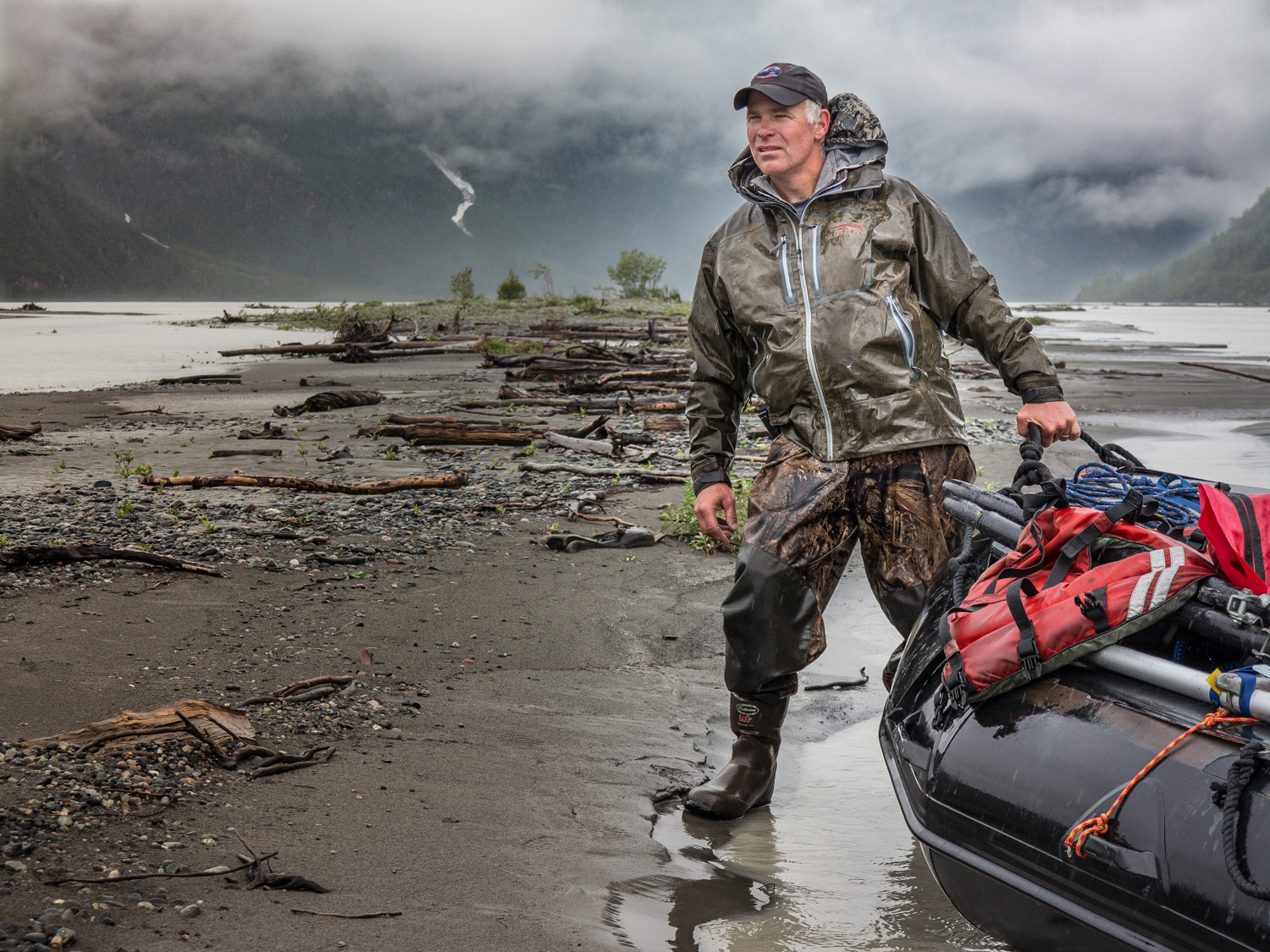
Copper River, Alaska. Steve Johnson. July, 2013.
This is an edited version of an essay published in the summer 2021 edition of Forum Magazine. In this almanac of the wild, I recount the cinematic scale of rafting the Copper River of Alaska during the worst flooding of the season. Navigating this unrelenting kinetic force reveals a landscape where ancient wild salmon runs push through a brutal, uninhabited corridor—a stretch of wilderness bookended by deep indigenous legacies but deeply scarred by the industrialized history of the American West. From the old mining town of McCarthy to the flooded canyons downriver of Chitina, to the vast, braided channels near Gulkana, this essay explores timelessness and the earned friction of a physical reality in the Alaskan wilderness during changing times. It weaves together high-stakes survival in a 14-foot Zodiac, the raw, physical effort of bush pilots keeping remote outposts alive, and the hauntingly overgrown vestiges of the Copper River Railway. Ultimately, it is a reflection on the delicate difference between finding temporary happiness in these untouched landscapes and discovering the purpose required to reconcile our presence within them—a journey into a valley where the ghosts are still there, breathing quietly in the woods and along the banks of this iconic river.
A Copper River Almanac
Hell-Bent Against the Current
The moment we launched, the river revealed its scale. We were motoring up the Copper River in a 14-foot Zodiac raft during the worst flooding of the season, pushing against a raging current. The Copper had ceased to be a river. It was forcing its way through the mountains like an angry ocean, spilling into the adjacent forests, erasing the thousands of gravel bars that normally offered sanctuary. But now, the claustrophobia of the deep wave troughs meant that in places, we couldn’t even see the edges of the river surrounding us. Spray soaked us to the bone, leaving a heavy residue of fine glacial silt packed into every crevice of our clothing, the grit in our teeth, smearing our faces, painting our red life jackets gray. The self-bailing floor would flood with cold water and then quickly drain, over and over, while our meticulously lashed gear groaned and shifted inside the boat each time we slammed into a wall of water. Cresting a towering wave, the bow plunged into a deep trough, pitching the stern skyward and leaving our jet outboard screaming on the peaks of a rollercoaster ride.
At the tiller sat one of my oldest friends, Steve Johnson, his posture rigid and focused, contrasting the surrounding mayhem. A former Navy submariner and corpsman who had trained extensively on the open ocean in Zodiacs, he was merely falling back on institutional muscle memory in one of the most austere environments on earth. Through the course of the entire day, he balanced squeezing every ounce of power out of our outboard motor with the heavy knowledge that blowing the engine would plunge us into an immediate fight for our lives. Whenever possible, we used the river’s natural back eddies to build up speed, slinging our way through the steepest rapids with the water’s own momentum, then backing off the throttle just as we crested the drop-offs, blind to what hazards lay waiting on the upriver side.
Being this far down the Copper, losing the boat meant “walking out”—a desperate prospect. South of Chitina, the valley walls plunge so steeply into the river they choke the forest down to a claustrophobic sliver of green. To move through it is to fight an unrelenting tangle of devil’s club and woven alders. There are no trails, only dark, disjointed tunnels pushed through the brush by brown bears.
Navigating that maze means intruding in their habitat. Just inside the tree line, the thicket occasionally opens into massive, bowl-shaped depressions hollowed out of the dirt. Finding a half-dozen of them empty offers no relief—not when the damp earth still holds the sharp, heavy musk of wet fur, or when the crushed ferns are still slowly springing back to life. You don’t have to see them to know they hold absolute dominion over this valley, sleeping off the heat of the day after tearing up old salmon carcasses out on the gravel bars. Even if you manage to slip through their shadows unnoticed, you still have to blindly wade across dozens of swollen tributaries hemorrhaging from the high peaks.
There were no places to land a bush plane for a flight out. If we had to walk, it would take a week or more of brutal, hyper-vigilant suffering. Because of this, we always kept a specific dry bag day pack in the boat containing a .44 magnum, ammunition, first aid, a sat phone, bear spray, extra clothes, and fire starter. The mandate was more than implicit. “If we end up in the water,” Steve had warned me on all of our river trips down the Copper, “we have to get to shore with that bag, because it will be hell without it.”
My job, positioned up near the bow, was to stay fully focused on the oncoming hazards. Instead, with the outboard howling behind me, I found myself dangerously lulled into contemplation when an ominous form crested the horizon line in front of us.
It was a massive, old-growth white spruce, nearly ninety feet long. When it began to pass by us, the surreal anatomy of the tree became undeniable, a staggering illustration of the river’s raw power to dislodge such a colossal anchor from the bank. It was a perfectly healthy giant, one that had survived countless previous floods, now being tossed around like a tiny piece of driftwood. Prolific, enormous branches draped off its massive trunk, dragging heavily through the undulating waters. The former matriarch of the forest was still fiercely alive, its branches deformed and snapping under the immense pressure of the churning current. Its limbs shook in the boiling water like arms desperate for something to grab. As it slid past us, its massive root system was fully exposed, still gripping raw dirt and boulders that were actively calving off and splashing into the murky water.
Our overtaxed outboard screamed to gain inches, while the magnificent giant rushed effortlessly past. For a few suspended seconds, the chaos of the river gave way to a somber stillness, watching her massive root system slowly disappear behind us in the current. But the suspension was short-lived. The terrifying speed of the river swallowed her quickly, pulling her into the maelstrom and leaving behind only the dank aroma of the forest.
The Invisible Deluge
The absolute ferocity of the water was jarring, especially given the deceptive calm that had lured us to sleep just twelve hours earlier. It was mid-summer, the height of flood season, but when we launched the Zodiac at Chitina the previous morning, the Copper felt entirely manageable. We had spent an easy day floating fifty miles south into the heart of this remote valley, eventually pulling off the river to pitch our tent on a high bank near the confluence of the Tasnuna River. Now, under these flooded circumstances, there was zero margin for error and no safe place to simply exit the river. To safely refill with extra gas we had carried, we had to hunt for tributary mouths and fight our way up them just to find a patch of solid ground to beach the raft.
What we didn’t know—but would find out later—was that massive thunderstorms had been raging all night long across the immense upper Copper River basin, far beyond our sight and hearing. That invisible deluge, combined with typical warm summer temperatures and heavy glacial melt, culminated in torrential peak flows.
The first warning came the next morning, not as a sight, but as a distinct audible shift in the valley’s frequency. Though our camp was safely elevated high above the water, the moment we woke up we could immediately tell the river’s voice had changed, deepening into a heavy, guttural rumble. When we finally looked over the edge of the bank, the river had risen more than five feet overnight and was still aggressively climbing. Staring at the churning debris, we contemplated staying put at our Tasnuna camp for a few extra days to wait it out. Ultimately, we packed up, thankful we had brought so much extra fuel, and decided to make a run for it.
Trying to force a fourteen-foot rubber boat up that torrent made the true scale of the Copper undeniable. We weren’t just fighting a flooded river; we were pitted against the drainage of a massive watershed measuring more than 24,000 square miles. It would ultimately take us hours of grueling throttle and nerve to finally beach the Zodiac safely back at Chitina, but mere survival was never the point of our time here. We hadn’t come to conquer the valley; we had come to be fully embedded in its uncompromising character. For Steve and me, this trip was one in a long list of defining moments that forged a deep, enduring friendship over several decades and many miles in wild backcountry. We deliberately sought out these spaces to strip away the guarantees and comforts of the modern world. In that shared vulnerability, surrounded by such incredible, indifferent wild beauty, we found exactly what we were looking for. Being in the thick of it didn’t just make us feel lucky to survive—it made us feel fiercely alive, reminding us exactly what makes life worth living.
That grey, silty water surging past our raft tubes was fed by hundreds of glacial tributaries spanning four distinct mountain ranges, a massive hydrological system that daily carries a staggering volume of sediment and glacial flour to the Gulf of Alaska. To local Athabascans, who named it Ahtna for the metal in the Wrangell Mountains, the river’s raw, silty power serves as the foundation of an intact ecosystem that has supported wild salmon runs and indigenous subsistence for thousands of years, long before our own relationship with the fish became so problematic.
An Alien Intrusion of Industry
It is also actively erasing the industrialized history layered on top of it. On another trip down the Copper, thirty miles downriver from Chitina, Steve and I found the vestiges of an old railroad grade. Tall wooden pilings once formed a bridge across a giant eddy in the river. Ice jams and previous floods had destroyed it, shearing off the thick pilings like broken toothpicks. The remaining railroad tracks spanned the gap, about two-hundred-feet across, but were hanging in the air—thick steel rails, unsupported, twisted and bent like wet clay by the unrelenting kinetic force of the river.
Between Chitina and the Copper River delta, much of the original Copper River & Northwestern Railway has met a similar fate, obliterated by the forces of nature. Yet, what remains speaks to a profound legacy. When you first encounter some of the larger structures left behind to rot in the alder, you realize how hidden they are from a distance. One particular trestle, massive at nearly five stories high, cannot even be seen until you are standing next to it. A short walk through the forest reveals its full, looming presence. When the crews erected this massive framework sometime between 1907 and 1911, they would have clear-cut the surrounding timber, leaving the geometric giant starkly exposed against the austere landscape. The milled timbers still bear the marks of the men who built it without modern cranes, employing brains and muscle to hoist, fit, and bolt every heavy timber, joint by joint, all by hand.
Today, an entire century-old forest of tall cottonwoods has swallowed it whole. It is as if the massive trestle willingly acquiesced to the canopy, sharing a hidden language between the living, emerging forest and the ancient, milled trees used to build the bridge. My fascination with the ingenuity of the construction is entirely eclipsed by this reclamation. The pride of the workers remains deeply etched in the joinery, but in this valley, the forest always has the final word.
That quiet acquiescence extends down the line. An active bear trail passes by a pristine section-house, its weathered exterior still holding onto its original iron-oxide red paint. Inside, the bright white walls are covered with dried, muddy paw prints from curious brown bears—stamped across the room like ancient hieroglyphics left behind by a forgotten people. Anywhere in the Lower 48, a relic of this magnitude would either be cordoned off as a protected national monument or destroyed by vandals. But here, deeply insulated by the remote Alaskan wilderness, it remains unknown and undisturbed.
Farther downriver, the vestiges of a riverboat depot stand obscured by the overgrowth. Walking into the dining hall feels weirdly pristine; cast-iron pots and pans still hang securely on the kitchen walls, and an adjacent room is filled with heavy, rust-pitted tools. It looks exactly as if the crew simply dropped what they were doing, walked out the door into the forest, and never came back.
A Brutal Personal Paradox
The Copper is so powerful it often seems inalterable by humans. Yet, the copper pulled from the nearby Kennecott mines helped wire the expanding American West, fueling a march of progress that would eventually dam other mighty waterways like the Columbia River. In 1938, copper prices plummeted about the same time the rich ore ran out at Kennecott, signaling the closure of the Copper River Railway. The valley would have begun reclaiming the affected land almost immediately after the last train left for Cordova.
But the human drive to extract resources from Alaska didn’t vanish; it merely shifted its focus from ore to oil. Half a century later, the Exxon Valdez oil spill forced a new reckoning. In the aftermath, research into the psychological impacts of the devastation yielded a Gordian knot, leaving a question unsolvable by conventional means: What is a way of life worth?
It also exposed a brutal personal paradox. A lot of people made a really good living immediately after the catastrophe by working for the oil industry, and I was among them. That time forced a realization of my own hypocrisy—a fierce love for wild places clashing directly with the knowledge that tangible forms of work and the alteration of nature are exactly what make my presence there possible.
As a carpenter who understands the satisfaction of physical labor, I feel a deep kinship with the men who built that railway. I don’t lament the physical relics they left behind; the forest has poetically reclaimed their wood and steel. What haunts me is the legacy their ingenuity inadvertently spawned. They laid the groundwork for an era of resource extraction with absolutely no bounds—industries operating with staggering footprints, a sometimes ruthless disregard for the environment, and the inevitable “resource curse” left to hollow out the communities in their wake.
I am only just beginning to learn the delicate difference between finding temporary happiness in these untouched landscapes and discovering the actual purpose required to reconcile our own destructive participation within them.
The Company of Silence
Exploring this contradiction often requires stepping away from the river’s immediate pull. On a previous trip with Johnson, we pulled off the river south of Woods Canyon and forayed deep into the eastern Chugach Mountains. We spent a full day fighting through a guarding jungle of devil’s club and alder just to get above treeline, lungs burning and skin stinging from the thorns and countless battles with nettles, before breaking out onto the ridgelines more than 5,000 feet above the valley floor. For seven days in the alpine, we encountered no other humans, rewarded with an uninterrupted expanse of jagged peaks and sprawling tundra benches. Despite the vast distance, as long as we could see the distant river, we could hear its unmistakable, muffled roar that defined the ambient sound of the valley.
But the most prevalent disturbance occurred early in the traverse—the noise inside my own head, an anxious humming against the absolute vastness.
“In the company of silence is where you find the truth in yourself,” Steve once said to me, distilling three decades of insight into a salient piece of wisdom. “And you might discover the truth you don’t really like,” he added. It’s a gnawing feeling, a realization that the contradiction of comfort is that it kills people slowly.
The uncomfortable truth the alpine silence forces you to confront is how deeply we are implicated in that contradiction. The modern ease we crave is subsidized entirely by the heavy, landscape-altering machinery that strips the wild bare. We insulate ourselves from the elements, yet our survival depends on manipulating them.
“Work that has changed nature has simultaneously produced much of our knowledge of nature,” writes historian Richard White. But if nature is treated only as a resource, our knowledge merely preserves the status quo. For example, a volatile commercial fishing industry is being threatened by a growing abundance of farmed salmon, by ocean trawlers and their indiscriminate bycatch, by changing environmental influences we don’t fully understand, and by our tendency to think we can outwit mother nature, rather than learn from her.
In conflicts with nature, as in our conflicts with other people—we often meet the true enemy. Perhaps we aren’t distinct from the river. Maybe the river is us.
The Lift Equation
To comprehend that vastness from the ground is overwhelming, but the perspective shifts when you observe it from above, reading the landscape not just as a map of human ambition, but of ancient geological violence. During WWII, the Gulkana Airport was built in the southern interior, a hundred miles upriver from Chitina. It sits in the shadow of the massive volcanoes of the Wrangell Mountains, surrounded by an immense plateau of taiga forest. Ten thousand years ago, however, this entire basin was a colossal inland lake. Seeing the country from the air gives you a visceral sense of the cataclysm that followed. When that prehistoric lake finally breached, it drained southward with such ferocity that it blasted its way through the solid rock of the eastern Chugach Mountains, carving the deep, claustrophobic canyons of the lower Copper River. Today, a mile and a half west of the airport, the river’s braided channels meander quietly across the flat expanse of that ancient lakebed—a sprawling, peaceful contrast to the brutal gorge it left in its wake.
In early Spring of 2021, I traveled to Gulkana to meet with two bush pilots familiar with the region. Martin Boniek is a 61-year-old “cowboy at heart” and the owner of Copper Valley Air Service. Rick Snow, 70-years-old, is one of Martin’s pilots.
Attached to the large airplane hangar is the air taxi office and a pilots’ lounge. Built with 1960s-style wood paneling, the space punctuates an endearing brand of Alaskan modesty and is adorned with maps that give visitors a sense of the region’s immense scale. On a chalkboard, The Lift Equation is written out, expressing the seeming magic of flight for those whose lives depend on it. Underneath is a sober reminder in white chalk: “One bad decision can nullify a lifetime of good ones—Don Welty.” And below that: “One good decision can make up for a lifetime of bad ones—Jesus Christ.” On an adjacent wall, a tourist comment card from Texas hangs on a corkboard, addressed to “ANYONE!!!” and asking, “Where are the caribou?”—an apt summary of the state’s thorny relationship with its visitors.
The evening I arrived, the sprawling vastness of the taiga gave way to the condensed warmth of a shared room. I joined the two pilots and Martin’s family around a large table, passing heavy bowls back and forth for a massive spaghetti dinner. Before moving to Gulkana, Martin and his wife, Laura, had lived in the historic town of McCarthy, settling there long before its official population of “two dozen or so” was swollen by modern tourism. In the early 1900s, the town existed purely to support the laborers pulling ore from the nearby Kennecott mines at the terminus of the Copper River Railway. It was a place defined by raw, physical effort.
That ethos hadn’t completely vanished when Martin and Laura first arrived.
“We hauled our own water to our cabin,” Laura told me, resting her arms on the dining table amid the clatter of cleared plates. Fifty-eight years old, she is the mother of two adult kids and the manager of the family’s flight business.
“I used to think it was hard work,” she said, her voice carrying the quiet pragmatism of someone who has spent decades off the grid. “Until one day it occurred to me that millions of people in the world have to haul their own water every day. We take too many things for granted.”
The Friction of Physical Reality
Her sentiment struck at the core of a growing American divide: the heavy, earned friction of a physical reality versus the frictionless ease of modern convenience. In the Lower 48, technology has largely succeeded in erasing geography, rendering face-to-face interaction optional. But up here, distance is still an undeniable force. Having visited McCarthy in the 1970s and 80s, when the nearest telephone was a day’s travel away, I asked Martin how the town had changed.
He paused, looking past the table and staring out the window into the dark.
“People used to talk to each other,” he replied. “When the mail plane came in once a week, everyone would meet at the Post Office and have conversations. You’d stand around, catch up, see who needed a hand. It was an event.”
He wasn’t merely being nostalgic; he was mourning the erosion of a vital community ritual. In an environment where the margins for error are razor-thin, showing up in person wasn’t just social—it was a practical safeguard. But even at the edge of the Wrangells, the digital tide was creeping in, fundamentally altering how neighbors relied on one another.
“That doesn’t happen as much anymore,” Martin said ruefully. “People are busy. Now they text on their phones and communicate on social media. It’s not face-to-face anymore.”
Yet, despite the encroachment of screens, the harsh logistics of the landscape refuse to be entirely digitized. You can’t text a cord of wood into existence, and a Wi-Fi connection won’t pull a truck out of a snowbank. The demand for authentic, physical competence remains.

Rick Snow flying over the Chugach Range.
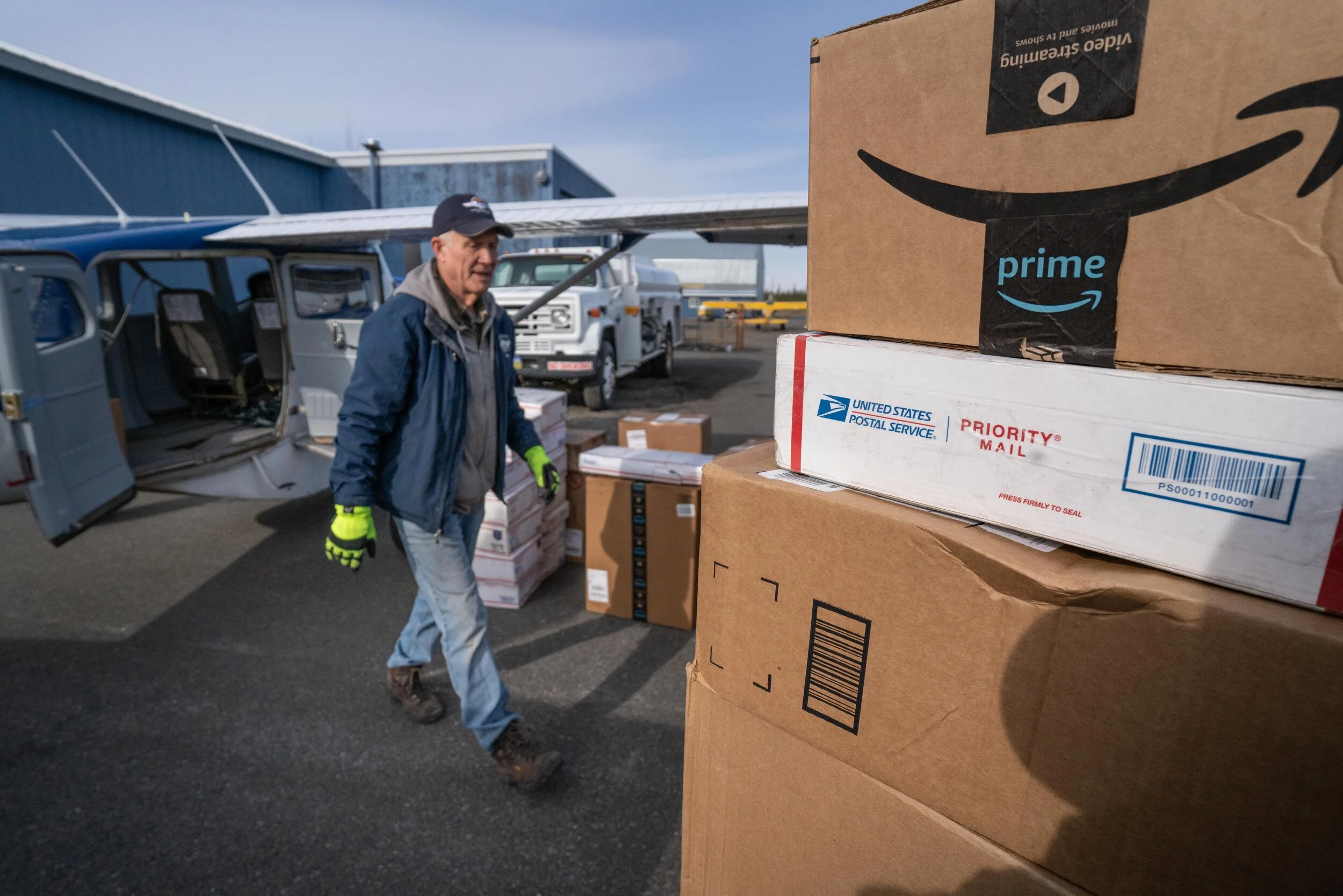
Rick Snow loading the mail plane for McCarthy. Gulkana Airport, Alaska.
That enduring reality was on full display the next morning. While the rest of the country was likely waking up to a flurry of weightless emails, I sat in the wood-paneled pilots’ lounge drinking coffee with Rick Snow. Despite being a full-time Alaskan, Rick possesses a quintessential midwestern demeanor, his furrowed features reflecting a lifetime of experience on the farmlands of Illinois. His aviation career began as a crop duster, then later on he worked in agricultural management, helping farmers become more efficient.
“Technology changed everything in this world,” he told me over our steaming mugs. “And it changed the people,” he added.
He went on to describe the sea change he not only witnessed but helped usher in.
“There’s a caliber of men and women we lost with the technology. The harder the land the better the people. The less they have the harder they work, the more understanding they are, the more giving they are, and the more hospitable they are. It’s one thing to preserve history, another to preserve the ideology and the values of the people who made history.”
A humble man who chooses his words wisely, Rick has an affinity for rural people, sharing a similar affection for bush pilots. “Flying has to have purpose,” he said.
Curious, I asked what that might be.
“Helping people,” he answered.
Shortly after, we headed out to the cold tarmac, where I watched Rick physically muscle the modern world into the back of an airplane. Aside from other general air taxi functions, Copper Valley Air holds a government contract flying mail to these remote communities. Rick loaded the cabin completely full, stacking heavy, taped cardboard boxes destined for the farthest corners of the earth. Squeezing past the freight, we buckled in, took off down the runway, and lifted into the sky.
“Copper Valley one-one-zero off with two souls on board and three and half hours of fuel en-route for McCarthy,” Rick said over the aircraft radio.
Gaining altitude, we passed over the Copper River and traded the formalities of commercial bush flying for the tight, mechanical confines of the cockpit. The floorboards vibrated beneath my boots, smelling faintly of avgas and oil, while the steady drone of the engine dissolved into the vastness of the giant sky outside. Thousands of feet below us, the Copper River snaked through the taiga, its braided channels glinting like scattered mercury.
After landing at the McCarthy airstrip, Rick unloaded the plane and left me behind to pick up another load of mail back in Gulkana. Knowing I had a few hours, I wandered around, inadvertently crossing someone’s wooded property, where I met a barking, three-legged poodle who ran faster than most able-bodied dogs.
Eventually, I found my way back to the airstrip, completely deserted until a local showed up. Driving a four-wheeler followed by that familiar, three-legged dog, he pulled up to me as I rested on a giant snowplow.
“So,” he said, cutting the engine. “You just hanging out?”
His question seemed loaded with the kind of suspicion you’d expect from a resident living in a place that doesn’t see a lot of outsiders during the shoulder season.
“Waiting for the mail plane,” I replied. “I think I might have accidentally crossed your property earlier.”
“Yah, I saw you,” he said, leaning over the handlebars. “When I heard my dog barking.”
I explained what I was doing, telling him I last visited McCarthy in the late 1980s. Nodding, he pushed back into his seat and relaxed his posture.
“That’s Odie,” he said, tilting his head toward the energetic black poodle. “He had an accident with a truck, but as you can see it didn’t slow him down.”
I soon learned I was talking with an affable longtime local, Malcolm Vance, 60-years-old, entertaining me with stories about his arrival in McCarthy in 1982. In 1983, Malcolm and his then-girlfriend were two of the five surviving residents left in McCarthy after the infamous mail day murders. The experience was so traumatic his partner abandoned her rural life, leaving Malcolm behind, then 21 years old.
“The murders were too much for her,” he told me. “But I stayed. I had already begun carving out a new life for myself.”
The following years provided a clean slate for Malcolm, with the harsh winters and wilderness lifestyle a steep learning curve. He persevered and ended up becoming a bit of a renaissance man, part of McCarthy’s more modern history, also a summer Bristol Bay commercial fisherman.
I asked Malcolm what McCarthy was like with the newfound attention.
“You know,” he answered, “my old man once said to me: Don’t be that guy who says—remember the good ole days. If you don’t like the changes you’re seeing, you better just pack up and leave. But I stayed. I may not agree with my neighbors about things, politics or whatever, and we might even fight about stuff, but if my house burned down, they’d be the first to help me start over.”
“So yeah, some things have changed, but that sentiment hasn’t,” Malcolm said, reaching down to scratch Odie behind the ears.
While Malcolm and I were still talking, Rick landed, and the three of us unloaded the mail plane.
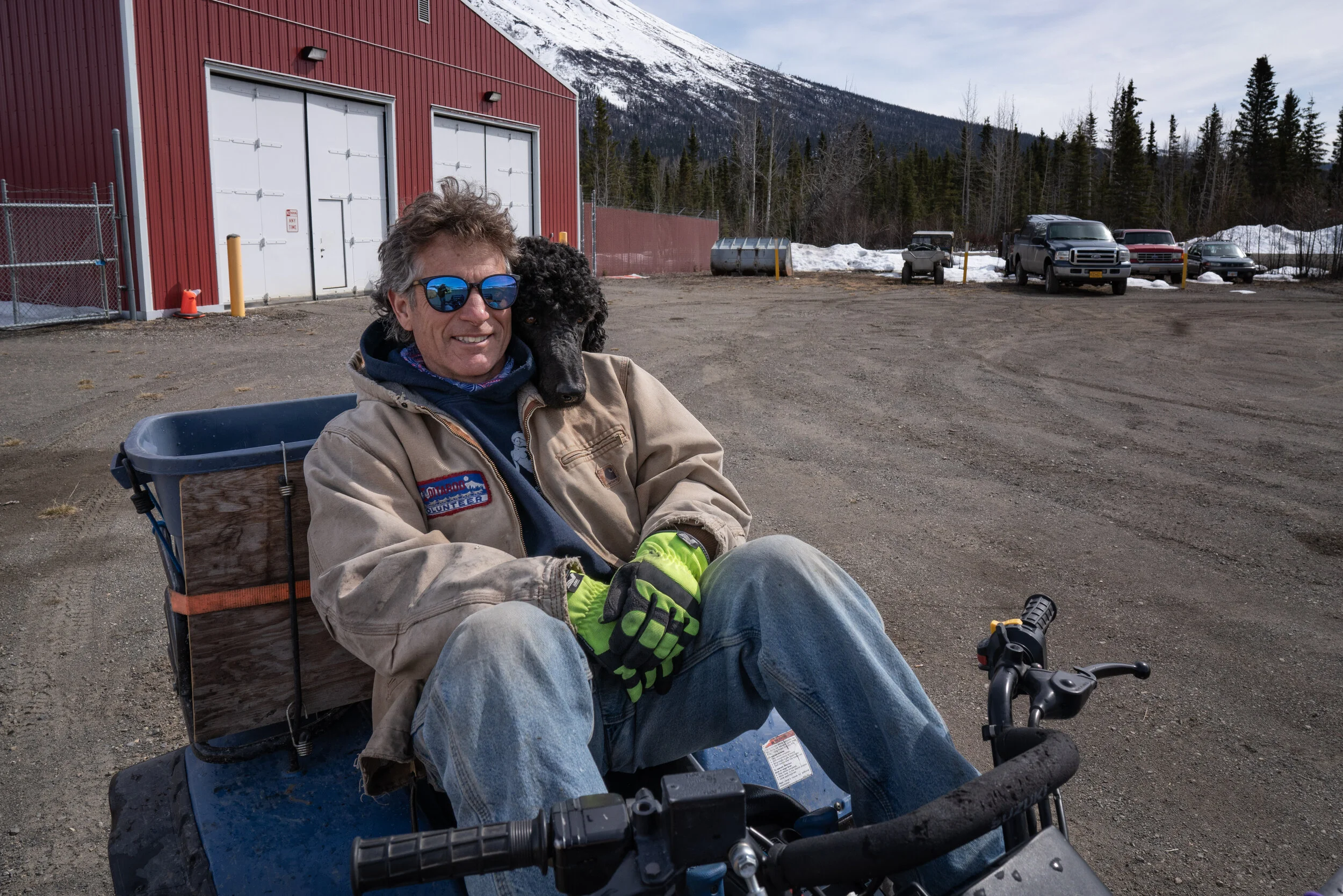
Malcolm Vance and Odie. McCarthy, Alaska.
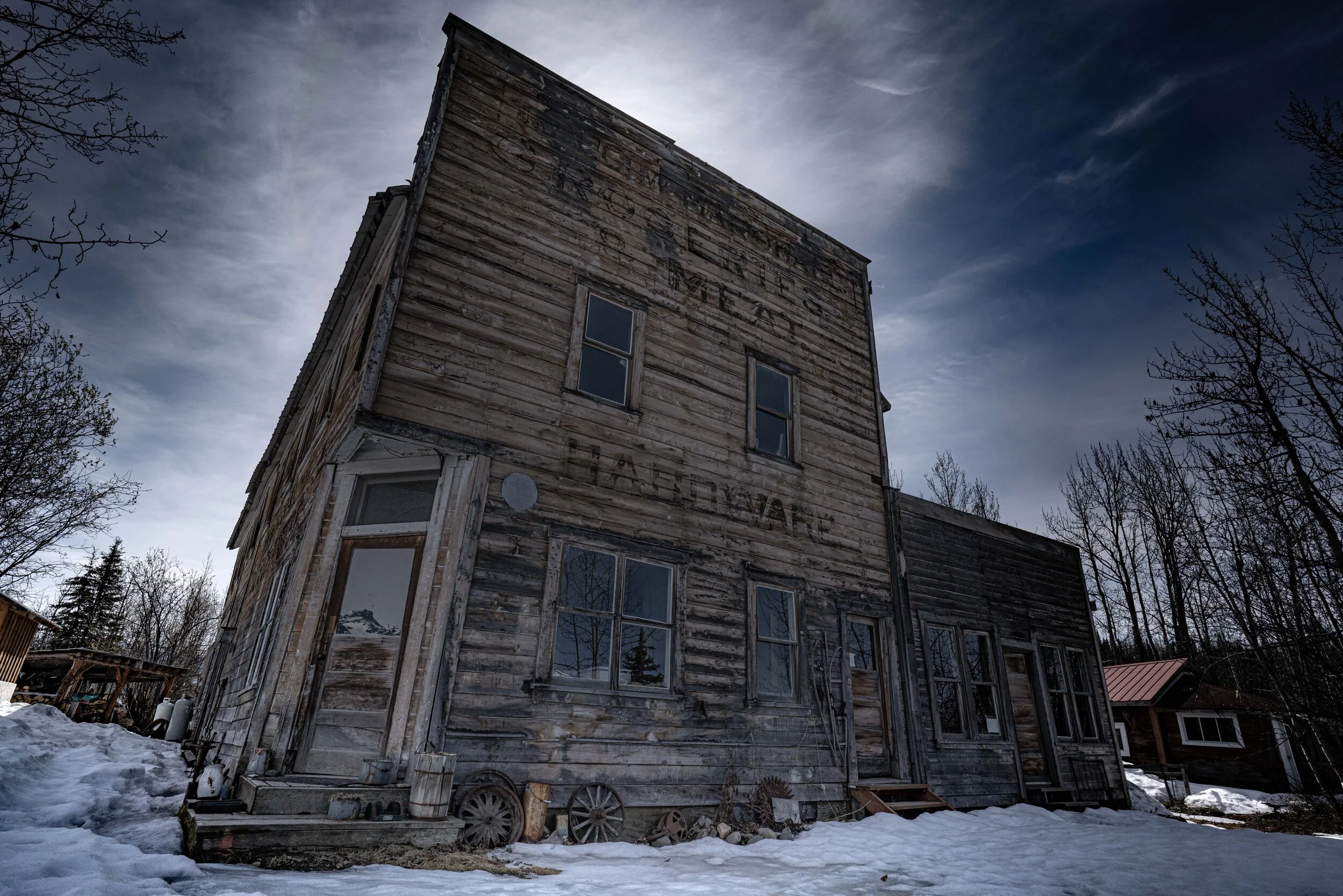
Phantom on the Rails
Flying back to Gulkana we detoured toward the confluence of the Chitina and the Copper River, where all my river trips exploring the lower valley have begun. One of these trips was in the early summer of 2013, revealing a Copper River entirely distinct from the churning maelstrom that would try to swallow us a month later. At low water, the river was lazier, its channels unfurling to expose abundant gravel bars and sprawling mid-river islands that would be erased during flood stage. This was an intimate river, one that invited deep contemplation and allowed us to finally drop our guard. We didn’t have to sit on edge; the water wasn’t actively trying to kill us.
We camped on a massive gravel bar about ten miles south of Woods Canyon. It was a warm evening and the feeling of remoteness was palpable. For miles in any direction, there was no sign of humanity—no tourists, no local boat traffic, no distant drone of bush planes. Just a vast Alaskan quiet and a slight, steady breeze that was just enough to keep the mosquitoes at bay. Trading our tent for the open air, we stretched out in the sand next to a driftwood fire and enjoyed a freshly caught, grilled red salmon cooked over open coals. Our bellies full, afterwards we cracked open a bottle of whiskey.
I had known Steve since the late 1980s. Over decades of navigating hard country together, he had become one of my closest friends. That bond was forged entirely in the raw exposure of the wilderness, built on a lifetime of shared experiences that spanned the sublime to the unforgiving. I remember lying awake in our sleeping bags long after midnight, our tent pitched on a gravel bar along the South Fork of the Kuskokwim River, listening to a curious pack of wolves howl from the edge of the pitch-black timber as they hunted caribou near our camp. It was a moment of profound, chilling beauty—a stark contrast to the times the landscape showed absolutely no mercy, like enduring a relentless, punishing storm that pinned us down during a traverse of the Alaska Range until our food rations dwindled to nothing.
But this particular evening on the Copper demanded none of that survivalist vigilance. Because the water wasn’t actively trying to kill us, we could finally drop our guard. As we passed the bottle back and forth, reminiscing about the weight of those shared experiences, the heavy adrenaline of the past dissolved into the vast Alaskan quiet. The evening settled into a profound, easy rhythm. In retrospect, knowing how quickly the years spool out and how certain voices eventually become confined to memory, I realize that quiet night on the gravel bar would stand among our most defining conversations.
Before long, the warmth and the whiskey took over. Steve dozed off in the sand, hypnotized by the poetry of popping embers and the constant, soothing rumble of the river.
About that same time, something got my attention in a nearby back eddy, a hundred yards away. Slowly emerging from the silty water, a black head as big as a bowling ball appeared, followed by a pair of round eyes. A large harbor seal.
I held perfectly still on the gravel bar, matching its quiet buoyancy in the lazy current. We watched each other for so long that a thick piece of driftwood in our fire finally burned through, collapsing with a soft hiss into the coals. Floating there in the eddy, I found myself wondering about its history, and its ancestors. Did they watch Athabascans netting salmon, long before the Russians came, before the explorer, Henry Allen? Did its ancestors watch the construction of the railway, curious about the noise and the dynamite explosions? Did this particular seal have these memories in its DNA?
Down on the Copper, I’ve come to expect these sorts of experiences—the oddity of a large marine mammal swimming more than a hundred miles from its home, up a freshwater river, following salmon. Eventually, it seemed to lose interest and dove back into the current, doing what it needed for survival. And that’s when the dichotomy struck me. I wondered then, if contemplation is a luxury or a curse, endeavoring to grasp something intangible, then watching it elude you. I wanted that ephemeral moment to last.
With my head resting against the rough, sun-baked bark of a massive driftwood log, I watched the alpenglow flare and deepen on the peaks high above us. Out in the eddy, the seal was likely off hunting salmon, whose animated bodies occasionally breached the glassy surface of the water. Steve and I were stretched out in the cooling sand, the nearby fire cracking and spitting bright embers into the descending dusk. Beyond the warmth of the firelight, the subtle, ambient murmur of the water created a deep, heavy stillness.
Lying there in the sand, with my partner still sleeping beside me, I drifted off to a much different time, back to when trains moved up and down the valley more than a hundred years before. Slowly, I could hear it coming up the corridor, emanating from around a mountainous corner—the distant steam engine chugging and hissing. Then came the agonizing squeal of heavy steel wheels grinding against the tracks. It was a rhythmic, violent sound, carried by the wind. It got louder, and louder, and closer, until it was undeniably real.
And then, as suddenly as it arrived, the mechanical roar vanished.
The profound stillness of the evening rushed back in, instantly replacing the train with the ever-present rumble of the river—a sound so constant it forms its own strange kind of silence. But the weight of the moment lingered in the cool air. The valley felt crowded; the ghosts were still there, breathing quietly in the brush and along the shore of the river.
The immediacy of the hard ground pressing against my spine shook me from the reverie. I looked over at Steve and noticed he was wide awake, his gaze set calmly on the dark water.
“Did you hear the train?” he asked quietly.
“Yes,” I replied.
“I heard it too,” he said.
We didn’t scramble to explain it away or question our sanity. Over decades of navigating the wild Alaskan landscape together, we had experienced the river’s strange phenomena so many times that the inexplicable had simply become normal to us, an expected, accepted part of our time down on the Copper. That glimpse into the past belonged to the place surrounding us, just as much as those heavy steel rails left suspended over the eddy miles away, twisted and bent by the unrelenting forces of the river.
♠
Epilogue
On my birthday in February of 2024, I received a phone call from Steve Johnson’s wife.
“Steve died,” she told me.
After decades of navigating hard country together, I had always braced myself for a different kind of call. Having sat next to him on countless hair-raising bush flights through zero-visibility weather, and having trusted him at the tiller while the Copper River tried to swallow us whole, I expected the wilderness to eventually claim him. Instead, the end arrived unexpectedly in the cab of his truck in Idaho.
His death felt incomprehensible. It defied the logic of a man whose immense physical strength wasn't built in a gym, but forged by thousands of hours hauling gear and surviving in the alpine. Editing this almanac brought him vividly back into the room—his distinct mannerisms, his booming laugh, and the terrifying calm he radiated whenever our margins for error completely vanished. We deliberately pushed into places most people avoid, seeking out that friction. Inevitably, when the harshness of the environment threatened to break my resolve, all I had to do was look over Steve, whether he was driving the boat in floodwaters or leading the way over a storm ravaged ridge in the Alaska Range. Steve would crack his trademark grin, offering a silent, undeniable confirmation that we weren't done yet.
His sudden passing is a jarring reminder of a truth the river tries to teach us: you rarely get to see the hazard coming. We spend so much of our modern lives insulating ourselves from risk, delaying our true pursuits, and waiting for the guarantees of tomorrow. But the timeline is never ours to dictate. Steve understood this. He didn't wait. He traded the comfortable illusion of safety for a physical reality of absolute, uncompromising purpose.
The void he leaves behind is massive, but it is exactly the shape of the life he lived.
I miss him.
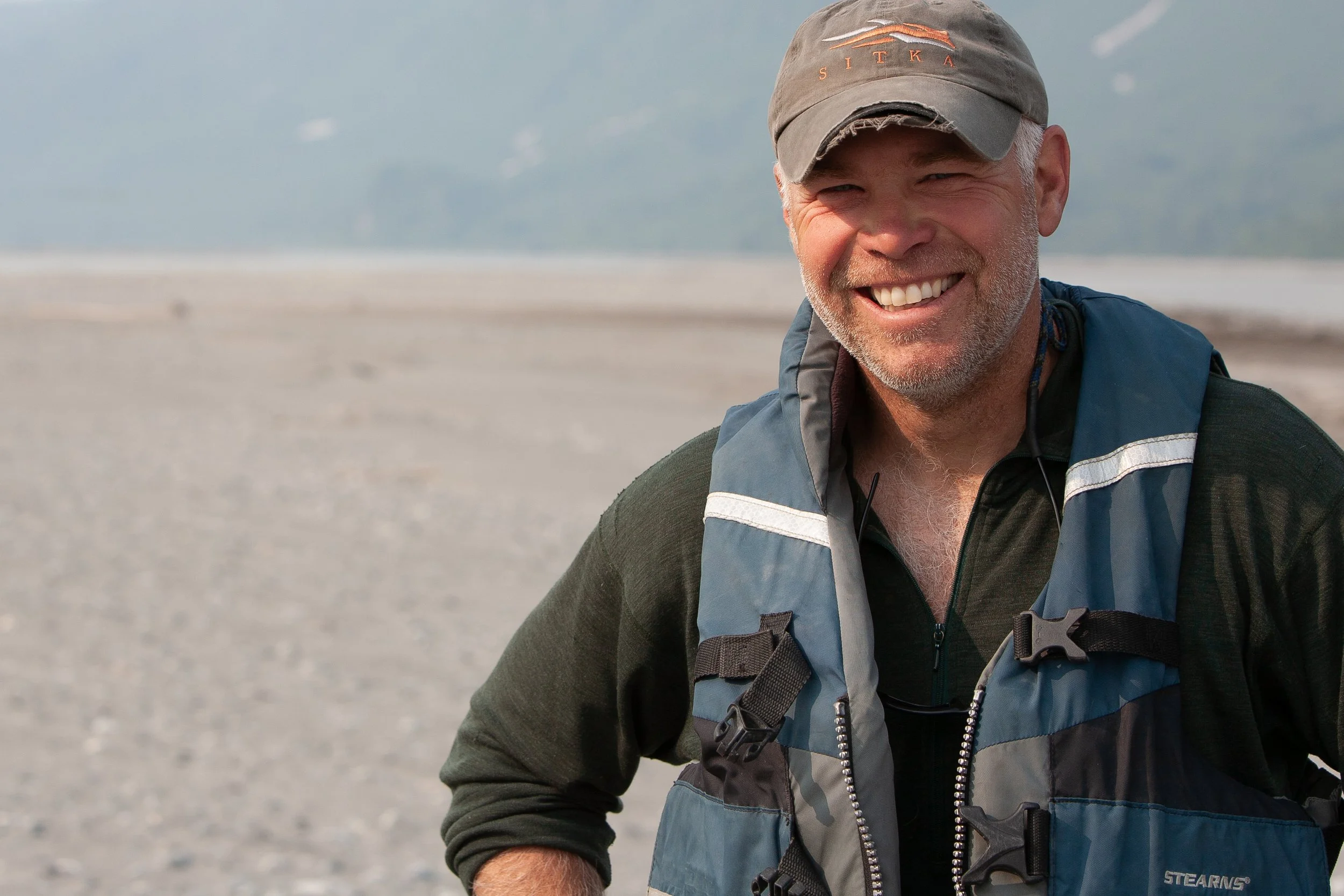
Steve Johnson at low water on the Copper River. May, 2013.