The Language of the Great Silent Places
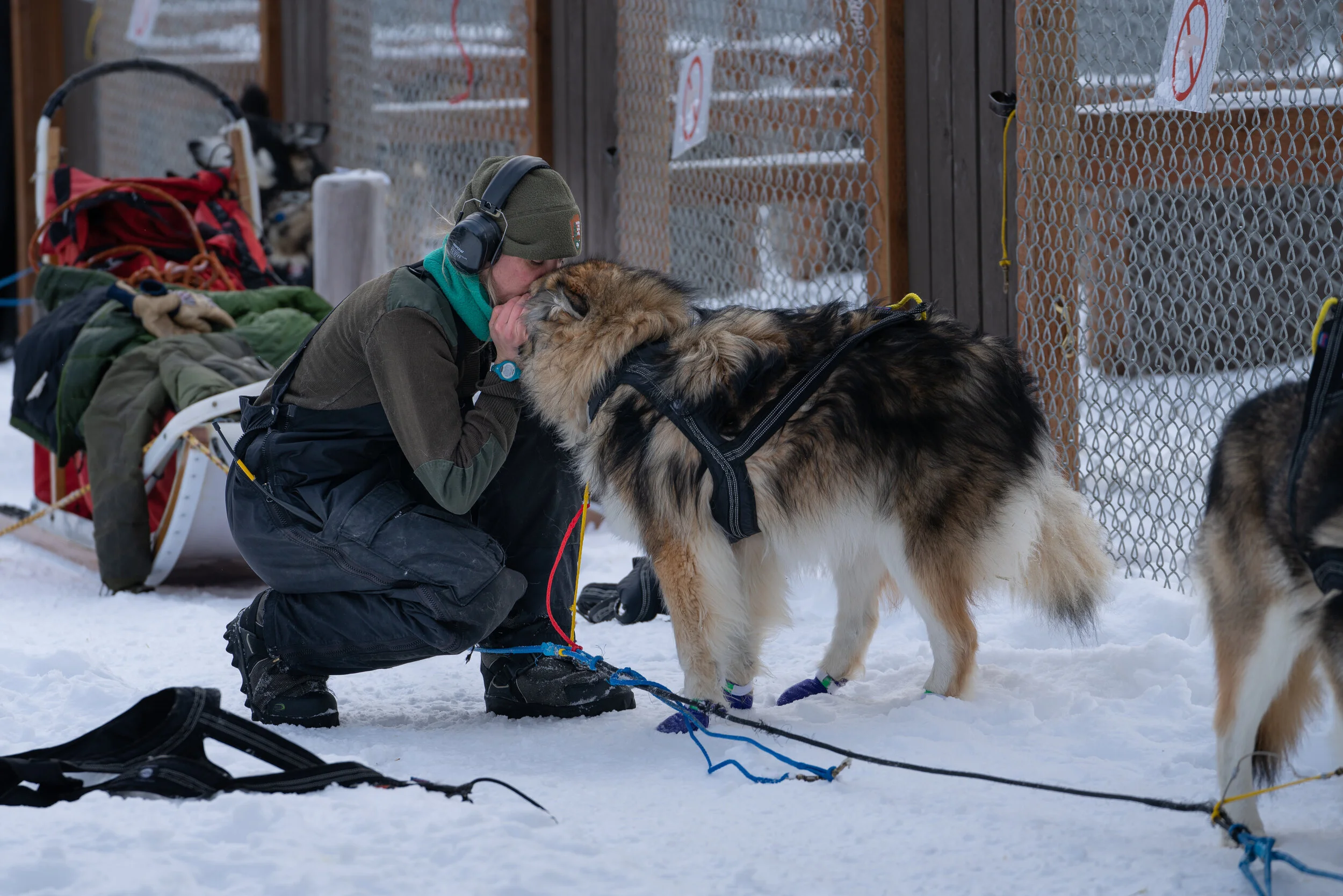
Author’s Note: Back in April of 2021, I traveled north to the Denali National Park Service Kennels and watched lively, animated huskies transform into disciplined wilderness athletes. In effect, a biting, ten-degree day did nothing to temper the unlimited enthusiasm of these dogs, whose diverse personalities and boundless energy completely define the atmosphere of the entire dog kennel campus. That visit inspired this essay—originally published in the spring 2021 edition of Forum Magazine—which reflects on the enduring value of doing things the hard way, anchored by the intense, palpable bond between the handlers, rangers, and the dogs themselves.
The essay's title is drawn from a 1924 speech given to the Women's Club of Anchorage by Harry Karstens, Denali's first superintendent. Attempting to convey the rugged nature of the wilderness he protected, Karstens noted: “There is little to offer visitors who need attendants to make them comfortable, who think of walking in terms of cement and board paths, riding in terms of cushioned motor cars... But there is much to offer those who understand the language of the 'great silent places.” Including this passage grounds the narrative in our shared Alaskan heritage, perfectly capturing that timeless, indescribable calm we still seek out in the backcountry today.
A loud voice cracks the stillness of cold winter air, sending echos across old spruce trees, radiating through snow covered forest. A song begins, joined by three more voices to form a chorus. Slowly, the accompaniment of six more voices rises into an anthem. Countless others add their voices, flooding the landscape with music so visceral, it overflows with emotion.
These passionate voices belong to thirty sled dogs, Alaskan huskies, each one with a distinct personality, all belonging to a complex social hierarchy, communicating in a way that might seem like a cacophony to some. But for the curious, for those who love nature and all its idiosyncrasies, the language of the huskies resonates with a transcendent quality that many of us yearn for—a connection to wild things, wild places, and deep meaning.
In the most primal way possible, these iconic canines are expressing a collective sense of anticipation, excitement for the opportunity to fulfill their life purpose: feeling resistance against their muscular bodies, pulling a sled through a winter landscape, carrying a human who has formed a bond with them, built on a relationship of mutual trust.
David Tomeo is one of these humans, serving in a unique position as the kennel manager for Denali National Park. The 51-year-old Park Service employee talks about the process of readying the dogs for work and heading out on the trail-putting harnesses on jubilant bodies, unfettered in their display of affection for their handlers, then strategically hooking each one to a tow line, finally setting off where the dogs are most at home, out on patrol.
“Forming a cohesive team, culminating in a singular focus,” says Tomeo, describing the orchestration of work, often done under the guidance of the assistant kennel manager, Julie Carpenter, also a veteran musher and a long time Park Service employee.
Carpenter is preparing three separate teams for a day trip out to a remote weather station. On a morning in late March, despite the growing daylight, Denali is still locked in winter.


Dog mushing kennels are common in Alaska and elsewhere in the northern latitudes, but there’s no other kennel in the world like Denali’s, supported by the U.S. federal government inside a national park. The dogs Tomeo and Carpenter work with are known as freight dogs, a breed different from their smaller, racing cousins. These are large huskies with muscular physiques, and thicker coats that keep them warm, traits that were once common in Alaska, long before it became the 49th State.
Carpenter and two volunteer mushers are nearly finished assembling their individual teams. Carpenter sorts things out by having frank discussions with each of the problem dogs. She casts a sideways look to reinforce the message. The dogs—all of them, see her as the alpha—and a source of intense love. Hardware jingles as furry bodies wiggle, some with delight, some with impatience. Lead dogs anxiously turn their heads, looking back to check progress. Claws paw at the ground, throwing snow on neighboring dogs. A flurry of tails, all wagging.
All three teams are like an array of loaded cannons, straining against the restraint of the tow line. Every single dog, beaming with intent, anticipating that feeling when they’re finally released, when the dog driver yells, “Hike!”
And then it happens: unruly dogs suddenly become disciplined wilderness athletes. Resolute faces atop a blur of legs, the hiss of sled runners, followed by a descending quiet, the snowpack absorbing all but the ambient sound of silence.
On this particular day, Tomeo stays behind to manage the day-to-day operation. Relishing a moment of peace, he summarizes what just unfolded. “It goes from chaos to focus,” he says, watching the last team disappear into the woods.
Tomeo spends a good part of his time carrying on a 99-year-old tradition, working a few miles up the road from the park entrance, where the kennel was relocated in 1929. Built in that same year, a two-story log cabin still stands, one of a handful of structures in Denali that reside on the National Register of Historic Places. The preserved cabin remains fully functional, still serving the current kennel staff, supporting their mission, caring for the dogs, preparing for multi-day wintertime patrols, expeditionary field science support, and frequent daily runs to train the dogs. All of these outings are conducted within a relatively undeveloped park that’s eight times the size of Yosemite, but with a fraction of the amenities, including roads.
A blanket of quiet lays over Denali in winter, by far the longest season, when the land remains pristine, save for the meandering tracks of Denali’s wild animals, and occasionally, a single ribbon of trail revealing where the dog teams travel across the park.
Inside the original kennel building, the smell of leather and oil is punctuated by the squeak of old floorboards. Shelves are loaded with a veritable library, chronicles of history, backcountry manuals, books on dog physiology. Cabinet drawers full of dog sled parts, and below that, tools for repairs. Dozens of dog harnesses hang from the walls. Winter gloves, strung on a clothesline. Among a neatly organized hodgepodge, rough cut beams display nameplates of every dog who has made Denali home.
Celebrating a long lineage of huskies, some monikers give insight into demeanor, others suggest origins of bloodline. Names like Attla, Patch, Savage, Pingo, Lupine, and Pixie. There are dozens more, names of legendary places, nicknames suggesting femininity, playfulness, shyness, leadership.
Tomeo talks about the purpose for using a seemingly antiquated mode of transportation, painting a stark contrast to faster and easier methods, like snow machines and helicopters. “The concept of wilderness, and restricting what happens in the wilderness, can sometimes be an abrasive thing to relay to people,” he says.
“But using these dedicated canine rangers and this unique method of travel, helps convey the importance.”
“The dogs are one of the top attractions at the park," he says. "They've become great ambassadors.”


Tomeo's attributes lend credence to his words, having the weathered look of someone comfortable in harsh elements, a quality complemented by his Alaskan stoicism. He’s spent the last twenty years working in different capacities associated with the park, which partly explains why he’s so fluent in Denali’s rich history. He talks philosophically about the value of cultural traditions, letting the physical artifacts around him—the library, the old harnesses—serve as a portal into Denali’s history before and after it was federally designated as a park.
Dating back to the late 1800’s, small teams of explorers began reconnaissance of the region, leading to interest in claiming the first ascent of then-named Mt. McKinley. Around that same time, hundreds of would-be miners arrived too late to capitalize on the Klondike Gold Rush, and those still struck with visions of gold ventured to more remote locations, one north of Denali, where gold was discovered in the Kantishna Hills. The area was lit with frenzy. The objective of most early explorers and miners was resource extraction and conquering high places, activities that were often done at any cost.
Ironically, these “discoveries” and early explorations were made in a region already well known to Athabaskans and even earlier Alaska Natives, the later dating back 13,000 years, who left such little trace of their existence it required deliberate efforts of National Park Service archeologists to actually find evidence of their passage, left behind in nomadic hunting camps.
Much farther north and east, dating back long before the time of early, white exploration, Inuits made use of dog teams beginning at least 2,000 years ago, and the modern Alaskan husky is thought to have descended from their northern, coastal cousins. Over a hundred years ago, the use of sled dog teams was prolific in the Denali region, at first supporting exploration, prospecting, and even unchecked harvesting of game used to support the rise of new activities and life in the growing town of Fairbanks. Professional “market hunters” would kill countless sheep, moose, and caribou and haul the meat away to sell, feeding the influx of people. Hunters may have naively believed that resources were unlimited.
It took the vision of an unlikely conservationist to signal alarm. Denali’s natural bounty had limits, and a wealthy hunter-turned-naturalist recognized this. Originally from Vermont, Charles Alexander Sheldon made three trips to Alaska, the first in 1906. His last trip cemented his concern, compelling him to use his connections and political savvy to convince congress to establish Mt. McKinley National Park, which eventually happened in 1917.
Surprising to some is the fact that forming the park had nothing to do with honoring the tallest mountain in North America, and everything to do with preserving the flora and fauna that existed in its shadow. Something First Alaskans had already been doing, Tomeo points out.
“Thousands of years before Charles Sheldon, Alaska Natives were coming through this area and making use in a way that left little impact.”
In that same tradition, Tomeo says, “There’s some value in knowing there are places where there’s wilderness, where it’s relatively untrammeled by human development, and human incursions into those areas are as minimally impacting as possible.”
“We’re using the least impactful tools possible, the most historic mode of travel,” he says.
Tomeo describes how conducting sled dog patrols into the park is a good metaphor in discussions with park visitors. During the summer tourist season, staff at the kennel sometimes face skeptics. Visitors ask, “why would you do it the hard way?”
Tomeo responds philosophically, “There’s a whole lot of things we could make more efficient.”
“Why not just whip out your smart phone?” he says with a hint of sarcasm, but then explains valid reasons for learning in more authentic ways, resulting in knowledge that becomes more intuitive, more meaningful.
In some cases there’s value in doing things the hard way, he professes, similar to the effort required to preserve our heritage. “There's value in that process,” he says, especially in passing on knowledge and history.
“We’re preserving traditions to help carry forward stories, the stories of our elders,” he explains, evoking the notion that our culture benefits from people and agencies tasked with preservation.
“Being stewards, we need to watch out for death by a thousand cuts,” Tomeo says. “Otherwise, your baseline for what's historic changes,” implying that one compromise can lead to another, and another, and then an unraveling of the very fabric that forms our culture, leaving us with nothing of importance to pass on to future generations, leaving us unmoored.
“This wilderness was preserved, and development kept out, for the American public now and the American public in the future,” says Tomeo.
“Imagine if you could only see bears in zoos, or if you could only see dog sledding in old videos.”
When Sheldon explored Denali in the early 1900's, he hired a veteran dog musher as his guide, Harry Karstens, a true Alaskan sourdough who would later be on the first ascent of Denali. Knowing Karstens’ reputation for being tough and uncompromising, Sheldon was instrumental in Karstens being selected as the first superintendent of the park, a time when dog teams were used extensively, including on poaching patrols.
When the park was in its infancy, no one knew the land better than Karstens. It’s likely he also knew how dependent he was on his dogs, for without their help and companionship, he never would have learned “to understand the language of the great silent places,” as he aptly described Denali to a meeting of the Women’s Club of Anchorage during his tenure.
Perhaps Karstens also understood how dogs reveal our intentions, reflecting our better selves, our mindfulness, and what we choose to nurture. The dogs reveal the truth inside of us.
Denali’s dogs are a bridge to a world we are always at risk of losing touch with, places that deeply inspire those who love nature, especially Karstens, when he said, “Here will be found an indescribable calm.”
Even among howling huskies.
♠