The Emotional Battlefield
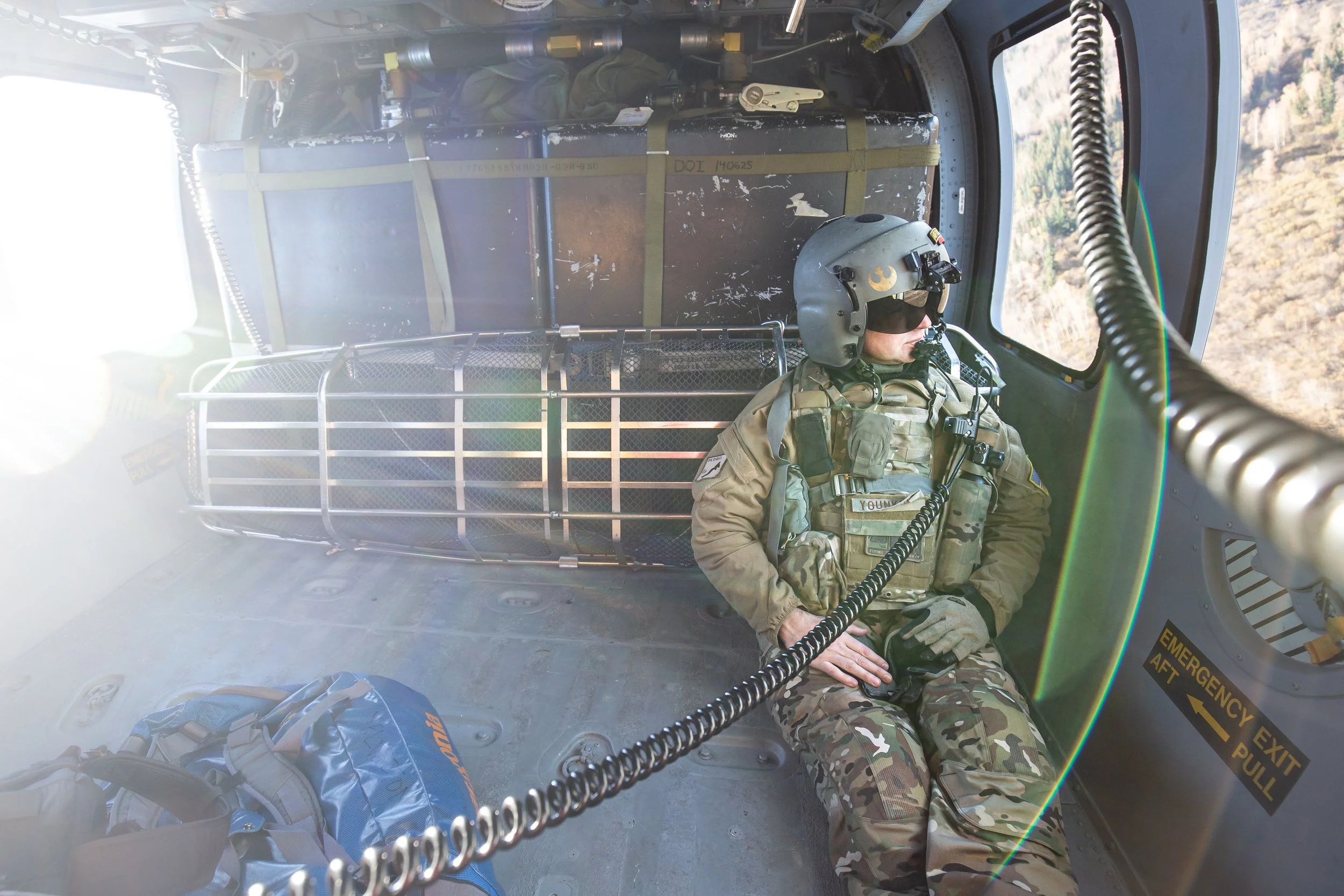
Author’s Note: Originally published in the Winter 2023 issue of Forum Magazine, “The Emotional Battlefield” grew out of Unseen, a project supported by grants from the Rasmuson Foundation, the Alaska Humanities Forum, and Duty Bound, an initiative exploring the experiences of Americans connected to military service.
The essay follows Master Sergeant Turk Younkins, a former Air Force and Alaska Air National Guard aviator who served with Alaska’s 210th Rescue Squadron. After two decades supporting combat and civilian search-and-rescue missions, Younkins came to recognize how deeply the experiences of war can shape a family—and how much he had in common with his grandfather.
After midnight in late summer of 2016, a veteran helicopter crew from the 210th Rescue Squadron struggled to penetrate dense fog, forcing the two pilots to fly close to the ground, relying on a pair of special mission aviators in the back of the helicopter to help “drive the ship” through a passage in the forest.
One of these aviators, Turk Younkins, leaned out of an open window on the helicopter’s side, judging the distance to the surrounding hazards. Via his headset microphone, he called out instructions.
“Continue. Easy forward 10, down 5.”
Through his night vision goggles, Turk surveyed a ghostly scene—everything colored with a monochrome shade of green, the neighboring trees bathed in the same surreal hue, but swaying in rotor wash as strong as hurricane-force winds.
Forty-two years old at the time and with two decades of military experience behind him, Turk understood the perils of flying night missions on board a 20,000-pound rescue helicopter, feeling the peculiar comfort of having life distilled to its most simple elements, when decisions become instinctual, and every action appears choreographed.
The six-man alert crew, which included two pararescuemen, made its way to one of Southcentral Alaska's most popular waterways, a river frequented by whitewater enthusiasts. There, the team began searching for the victim of a rafting accident that had occurred late the previous day.
“I convinced myself he might still be alive,” Turk remembered.
The only missing person from the accident was a boy and his young age catalyzed the team’s resolve.
But as the night wore on, hope faded.
“We became obsessed with finding him,” Turk said.
“I found myself wanting closure for his family,” he added, visibly restraining his emotions.
After flying numerous grid patterns above the river and nearly giving up, Turk spotted something that looked out of place. He guided the pilots to a bend in the river, asking them to hold a hover so he could focus on an anomaly in the water.
Turk studied the object through his night vision goggles, realizing it was the boy. Straining to lean out of the helicopter, he asked the pilots to move the ship closer.
Turk saw the boy’s face and was overwhelmed with dread, an emotion he knew from recovering the bodies of dead soldiers in Afghanistan, performing CPR on mutilated bodies in the back of the helicopter, and responding to civilian tragedies in Alaska.
But this time, something was different. As he watched the boy's head rise and fall in the water, Turk began seeing his own son's face. His son was home, safe in his bed, but Turk could no longer separate what he knew from what he was seeing. He froze, unable to speak or act.
Six years later, choking back tears, Turk remembered the experience.
“I watched his head bobbing in the water. He would go under the waves, and every time he would resurface, every time his head would come back up…” Struggling to compose himself, Turk found the words. “Every time he would come back up, I would see my son’s face.”
Turk has only a vague recollection of what happened afterward. His team members took over.
Two days after the incident, Turk entered his commander’s office on JBER. He hadn’t slept in the previous 48 hours, and it showed. He removed his aircrew wings from his flight suit, placed them on his commander’s desk, and said, “I can’t do this anymore. I quit.”
His commander responded, “Ok, but first, let’s get you help.”
That same day, Turk met with a mental health counselor trained to work with the special forces. Treatment followed, but it only got him out of the woods. He flew on missions for another three years, but admitted they were torturous.
Susitna Valley, Alaska, 2016: Rescuers from the 210th and 212th Rescue Squadron fly on a tactical training mission. PC: Joe Yelverton
“I would think to myself, what if I see another dead body? What if I see my son’s face, my daughter’s face, or my wife’s face? What if I lock up again and put the team in danger?”
Turk retired in 2019 with 23 years of military service behind him, most in search and rescue. A significant part of that occurred in Alaska.
To understand the trajectory of Turk’s life, it’s necessary to go back decades, even before he was born.
When he was twelve years old he visited Dachau, Germany, with his grandparents— Elmer and Alethea Gall. It was 1987, more than forty years after his grandfather had fought in World War II.
“He wanted me to see what the Nazis did,” Turk said, recalling his grandfather’s impetus.
“But partway through the tour of Dachau he disappeared,” Turk remembered. He did not understand his grandfather's challenges, especially the frequent nightmares, until many years later when his own military career began.
When Turk was an infant he lived in Littlestown, Pennsylvania, in a multigenerational household with his grandparents, his mom, and her two brothers.
“My dad was bigger than life,” said Stephanie Younkins, Turk’s mother.
Osaka, Japan, 1951: Staff Sergeant Elmer Gall, U.S. Army. PC: Younkins family.
She remembered that everyone in the family knew her father differently, “but we all knew to never disturb his sleep.”
“He tried to choke my mother in the middle of the night one time,” Stephanie recalled, describing the effects of her father’s nightmares. “But he was a role model to many, especially kids. He cared about people.”
“He was my role model and my hero,” Turk said, describing his fondness for the man who helped raise him, the only real father figure he knew. Turk’s biological father had a history of violent behavior, something his grandfather, Elmer, wouldn’t tolerate.
Elmer was a machine gunner in the U.S. Army during World War II. He was captured by the Germans but escaped. He was also seriously wounded. After his escape, he was taken in by the Russians, helping them liberate a concentration camp toward the end of the war.
“When he was dying of cancer, I asked him about the nightmares,” Turk said. “I wanted to give him the opportunity to talk about it. But I also wanted to understand.”
Turk recalled the story his grandfather told him. Out on patrol, Elmer was atop a wooded hill when he spotted a German tank headed for a nearby village, where American soldiers had taken up a post. Elmer lifted his bazooka and fired at close range, hitting the tank and igniting an inferno inside the crew compartment. Engulfed in smoke, the German crew climbed out of the vehicle, trying to escape. Elmer shot and killed each soldier.
After describing this horrific incident, Turk’s grandfather became emotional.
“They were kids,” he confessed to Turk. The German soldiers were just teenagers.
Despite receiving a Purple Heart and two bronze medals for valor, Elmer’s experience at war left him haunted for his entire life. And now Turk is haunted, too, not just by his traumatic memories but by the echoes of his grandfather’s anguish as well.
That legacy is a heavy load to shoulder, and it’s common among other Alaska military members and their families. It’s an unseen story, sometimes reflected by mere statistics of suicides.
When asked why he was willing to talk about his experiences, Turk answered, “I’m willing to do it with the hope that it will inspire others to share their grief.”
Kandahar, Afghanistan, 2003: Master Sergeant, Turk Younkins, 210th Rescue Squadron, Alaska Air National Guard. PC: Turk Younkins
Turk is now fifty-two years old and a single parent, raising two teenage kids, along with help from his mom and stepdad, who also live in Alaska. Turk attributes his two divorces to his struggles with trauma. But he’s proud of his military service, proud that he could help others, including civilians, and he’s especially proud of his grandfather.
Turk is now exploring the social work program at the University of Alaska. He wants to help other veterans, particularly by working to reduce the stigma surrounding post-traumatic stress.