The Fragile World of Prince William Sound
Authors Note: This is an edited version of an essay featured in the January 20th, 2020 edition of the Anchorage Press. "The Fragile World of Prince William Sound" explores the work of Rob Campbell, a biological oceanographer based in Cordova, Alaska, who has spent the last fifteen years studying the health of a rich ecosystem now in peril. The essay uncovers the unseen, dual impacts of a warming climate on the region's famously prized Copper River salmon and the broader maritime community. While local fishermen watch vulnerable fish perish in drought-stricken coastal streams, an equally devastating crisis is unfolding offshore in Prince William Sound: massive influxes of freshwater from melting alpine glaciers are heavily stratifying the ocean. Campbell’s findings reveal that plankton are being negatively influenced by both warming waters and an increasing lack of deep-water nutrients trapped beneath this freshwater layer. The result of this climate-driven change is an observable shift in plankton species and diminished concentrations of all plankton in the upper strata of the ocean where fish are most dependent on them. Why does a tiny little creature matter so much?
A scientist with a cold beer in his hand, Rob Campbell settled into his Adirondack chair, contemplating the autumn sun from the deck of the Reluctant Fisherman, a popular watering hole above the Cordova boat harbor.
Like other folks living near the coastal rainforest, the 47-year-old oceanographer was more accustomed to precipitation than sunshine, more used to rain-gear than short-sleeves. But in September of 2019, as with most of that summer, Alaska had experienced record-breaking temperatures. The locals seated around us were soaking up the rare warmth, yet the immediate irony was hard to ignore: they were enjoying the very heat that was actively endangering the town’s livelihood.
“Marine forecast is calling for two-foot seas tomorrow morning and early afternoon,” Campbell told me, his voice carrying an odd, distinguishing cadence—a blend of his native Canadian roots tempered by decades of living in Alaska. A good listener who weighed his thoughts carefully, he didn’t mull his words, delivering them with absolute certainty. “Becoming six to eight feet by late afternoon.”
The red-bearded mariner knew I would be with him the following day, on his research vessel, cruising to the center of Prince William Sound where I planned to document his work. And he knew we would likely be motoring back to port in the evening hours, straight into the front of a forecasted storm. Campbell is part of a rare breed, being an oceanographer and also the captain of his own research vessel, often heading out in conditions most people would strictly avoid, simply because his work demands it. But Campbell is wedded to the sea.
Months before I met him in person, we had first talked on the phone.
“Do you get seasick?” he had asked me, his tone characteristically defusing and warm.
As a carpenter and photographer who has spent decades in Alaska, I am accustomed to terrestrial labor. I had recently finished documenting glacier scientists in the high alpine adjacent to Prince William Sound. Up on Wolverine Glacier, lugging heavy gear across the ice, the physical demands made sense to my body. Gravity felt reliable. The earth, even when it is melting, provides a solid foundation. You can brace against it. But the ocean is a restless, three-dimensional void. My footing on land is absolute; on the water, it is entirely surrendered.
In hindsight, my answer to Campbell must have lacked confidence, because the day before our cruise he posed the next logical question.
“Did you bring Dramamine with you?”
Having some idea what the next day held, I sat on the deck of the bar and enjoyed the temporary feeling of solid ground.
Cordova is a place where saltwater runs in people’s veins. With a population of roughly 2,000, half of the families in town work in careers directly tethered to the sea. The boat harbor is the town’s most iconic fixture, yet during my time there, it was packed with idling fishing vessels. It was mid-September. The fishermen should have been working at a frenetic pace, chasing the last opener of the season as coho salmon headed to their spawning grounds. Instead, they were tied to the docks, doing boat maintenance and waiting for news from state managers.
In autumn, the average high temperature in Cordova usually hovers in the mid-fifties. When I was there, the mercury sat in the seventies. Over the chatter of the bar, Campbell described how an unprecedented coastal drought had left local streams bone dry. He painted a grim picture of salmon forced to spool up in the ocean, waiting for rain that wouldn’t come. When they finally pushed into freshwater barely inches deep, thousands of females, still full of eggs, were left stranded, suffocating before they could spawn.
The drought, however, is only one visible symptom of a broader climate crisis. Out in the ocean, a separate, unseen shift is occurring beneath the surface, and Campbell is intimately acquainted with the myriad aspects of this unraveling. The marine ecosystem relies on the thermohaline circulation—a deepwater renewal driven by a global conveyor belt of ocean currents. He explained how water exchange between the Gulf of Alaska and Prince William Sound dictates the region’s biological productivity. During the summer, when the strong winter winds relax, deep water from below the continental shelf break flows in through Hinchinbrook Entrance. This heavy, salty water arrives absolutely choked with released nutrients.
“In the summer we often get a relaxation in the winds,” Campbell explained. That seasonal lull allows the nutrient-dense water to slip all the way into the Sound. But the ocean’s mechanics are shifting. As immense volumes of freshwater pour off rapidly melting alpine glaciers, the ocean is becoming heavily stratified. A stable, warm layer of freshwater now caps the surface, effectively trapping the vital nutrients in the depths below.
“Plankton will almost always use up all the nutrients in the top layer,” Campbell told me, his voice carrying the grounded authority of a man who spends intense periods plowing through hard earned data. Because that top layer is now walled off from the deepwater renewal, he is watching those surface nutrients become entirely exhausted. The ocean is starving itself from the top down.
The farther he moved into the hydrodynamics of the Sound, the more his typical warmth gave way to a palpable unease.
I asked him what concerned him the most.
He let the question hang for a brief second before answering, unequivocally:
“Temperature.”
Early the next morning, we loaded provisions onto the 39-foot research vessel, New Wave, and slipped out of the Cordova harbor. Getting to the Sound requires threading through a shallow passage, where I watched a salmon burst from the water, its whole body flying through the air before landing with a heavy splash. Soon, the surface was punctuated by dozens of them, silver bodies flashing as far as I could see.
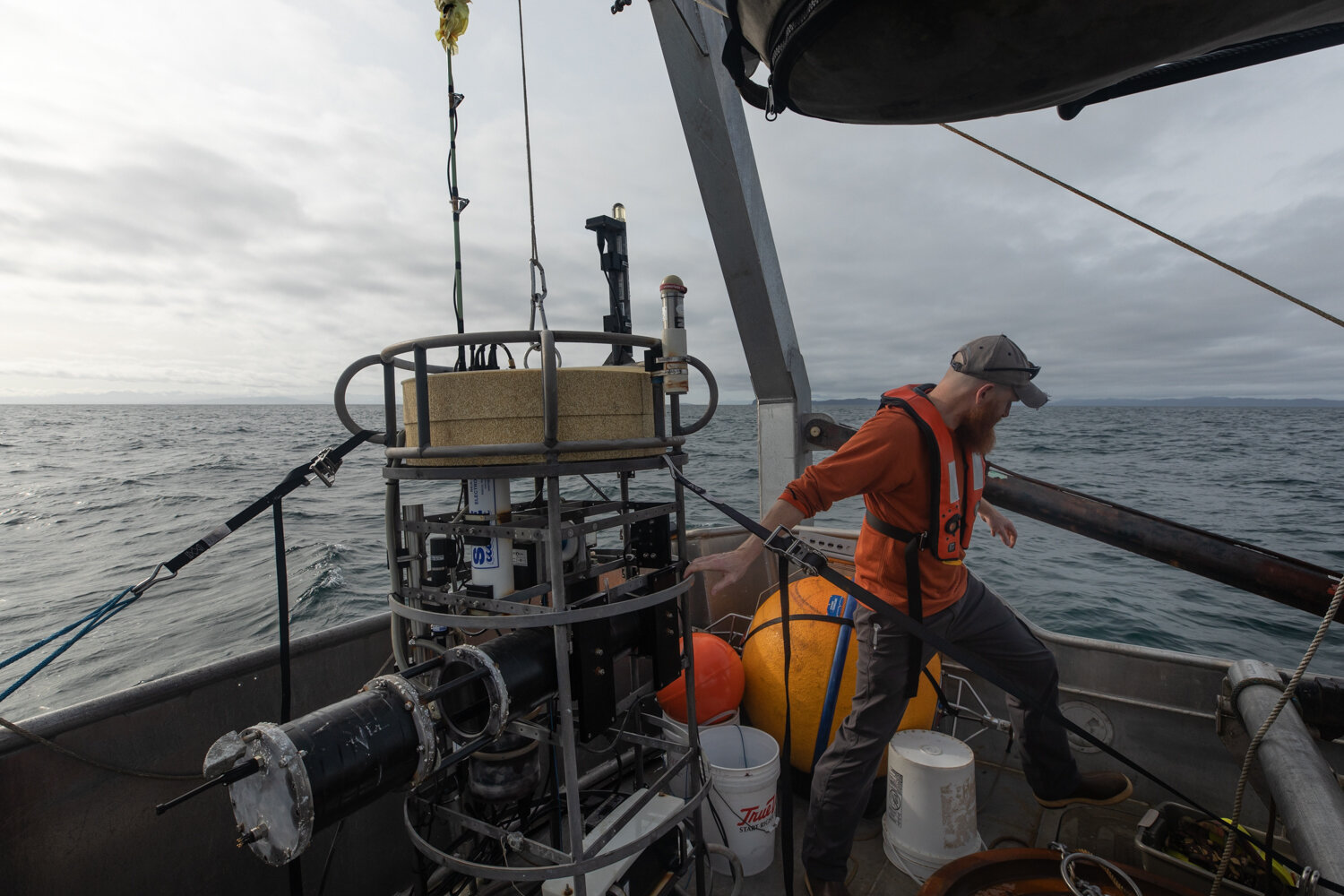
Campbell, along with his partner, biological researcher Caitlin McKinstry, planned to service an autonomous moored profiler (AMP) anchored to the ocean floor in the center of the Sound. About three hours out, marked only by his GPS, Campbell cut the power to the massive twin diesels.
Almost immediately, the vessel began pitching back and forth like a metronome. Campbell placed an acoustic transmitter into the water, cycling through frequencies to trigger the electronic hitch holding the AMP on the bottom. The rhythmic pinging sounded like something out of a Jacques Cousteau documentary.
Campbell caught me staring out at the chop, calculating the sheer mass of the water. He offered a disarming grin, but his eyes were dead serious, actively scanning the shifting deck. “No one has gone overboard on the New Wave yet,” he told me, his voice carrying that same grounded, absolute certainty. “So please don’t be the first.”
I took his words to heart. For fifteen minutes, we scanned the gray water until one of the buoys attached to the AMP finally breached the surface. Campbell motored over, and what followed was a stark lesson in the mechanics of the sea.
The New Wave swayed in the swell as we tried to wrangle a 300-pound device dangling from a winch cable. For a carpenter accustomed to solid earth, it was disorienting. It felt like wrestling a beast that could easily rip me over the rail. I struggled to synchronize my body with the unpredictable timing of the waves, desperately adhering to the mariner’s rule of one hand for yourself, and one for the ship.
But Campbell was entirely in his element. Smart as a whip but far from a stereotypical academic, his advanced mechanical and boat skills took over. He handled the massive AMP as if he were just shifting a heavy generator on a flat job site. Despite the deck dropping out from beneath our boots, for him it was a dance. He let the hoist do the heavy lifting while he gently guided the unwieldy robot onto the deck with a quiet, practiced grace.
After downloading the data and performing rapid maintenance, Campbell and McKinstry released the AMP back into the depths. Then, Campbell deployed a specialized net. The juxtaposition was jarring: using a 39-foot boat with twin diesels, heavy anchors, and mechanical winches in the middle of a violent ocean, all to harvest something nearly invisible.
My brain was still operating on terrestrial logic, where heavy rigging and industrial machinery equate to moving massive loads. Trying to make sense of the physical effort playing out on the rolling deck, I asked a question that immediately outed me as a complete novice to the ocean.
“How many pounds will you be harvesting?” I yelled over the wind.
Campbell paused at the rail and threw his head back, letting out a booming laugh that cut right through the noise of the sea. It was a good-natured chuckle at my expense.
“Not even one!” he shouted back, highly amused by the sheer absurdity of my assumption. “Grams. Like a grain of rice or smaller, and they’re mostly water. Just like us.”
He emptied the net, filling glass jars with tiny creatures pickled in formaldehyde-a hundred-year-old technique. McKinstry took over, labeling the samples on an organized work table inside the cabin. While I gripped the bulkheads as the boat bobbed and objects slid across the table, she worked with an unbothered, clinical attention to detail, totally immersed in the microscopic world.
Their research is revealing a grim shift: the larger, lipid-rich sub-polar plankton that form the bedrock of this ecosystem are being replaced by smaller, subtropical species containing fewer nutrients. It is an invisible fracturing of the food web, dictating the survival of everything from the salmon to the town of Cordova itself.
This is precisely where the stark reality of the ocean collides with state management. The working-class fishermen of Prince William Sound are bearing the brunt of a warming North Pacific, fighting the unseen consequences of marine heatwaves and a stratified ocean. Yet, state leaders frequently respond to these looming environmental shifts by insisting that more research is needed, while simultaneously leaving that very environmental monitoring to non-profits.
To a lifelong Alaskan, the disconnect is glaring. The state routinely demands flawless data before acting, yet systematically places administrative hurdles in front of the science. This pattern of neglect eventually culminated in June 2023, when the state legislature earmarked funding for a critical project to track the exact river origins of salmon caught by trawl fleets. It was precisely the kind of data required for sound management. Yet, the governor exercised a line-item veto, striking the money from the budget and blocking the state from independently collecting the very data it claims to require.
The hypocrisy is laid bare when you are out on the water. While state leadership retreats behind budgetary excuses, claiming marine research is simply too expensive during periods of austerity, guys like Campbell are out in undulating seas, doing the grueling, analog work to track the collapse, gram by microscopic gram.
At first, our trip back toward Cordova was under deceptively sunny skies. As the twin diesels hummed and we cut a clean wake through the chop, I sat in the cabin reflecting on the invisible harvest in those glass jars.
Traversing the surface of the ocean evoked a sense of an enigmatic world underneath us, but with inextricable connections to the terrestrial environment above. Two different worlds uniquely mirroring each other in the depth of their complexities.
That quiet contemplation was soon broken by a shifting barometer. The leading edge of the storm Campbell had predicted loomed ahead, painting the horizon in a bruised, indigo gray. The wind began to howl through the rigging, and the seas grew progressively rougher, turning into steep, chaotic walls of water. For me, it was a white-knuckle ride; I gripped the edge of my seat every time the New Wave plowed over a crest, the hull shuddering violently as it slammed into the deep troughs. Yet Campbell and McKinstry appeared utterly relaxed, content simply to be out on the water.
By the time we turned the corner into Orca Inlet, the sky had turned bruised and black. Campbell dropped me at the docks just as the rain began to fall.
After changing out of my heavy rain-gear, I walked back to the Reluctant Fisherman. Pushing through the doors, I found the classic, darkly lit bar nearly empty, a quiet refuge from the weather. The bartender was playing Mazzy Star, a slow-moving, hazy soundscape that perfectly scored the quiet isolation of a remote town weathering a blow. I ordered a beer and took a seat beside a long row of huge plate-glass windows overlooking the harbor.
Through the glass, the rain was coming down in relentless, driving sheets. The sheer fury of the storm was illuminated in the darkness by the halogen dock lights, casting a pale, shivering glow over the hundreds of slips where the Cordova fleet sat captive. It was a comfortable place to sit and watch a violent world. Plankton, despite being mostly water, hold the fate of this entire, massive ecosystem in their tiny, fragile bodies. We build cultures and economies around the salmon, but the salmon live at the absolute mercy of a microscopic world even more mysterious, and vastly more fragile, than our own.
After a while, catching my own reflection in the dark window, I felt the urge to leave the quiet warmth of the bar. I put my heavy rain jacket back on and stepped out into the deluge. The noise was absolute. It felt as if the entirety of the ocean was spilling down upon Cordova, a dramatic end to a suffocating season of heat. It rained for days on end, eventually filling the rivers and streams just enough that some of the late-season coho could finally push out of the saltwater, and go home.